Artificial intelligence has changed the way we interact with technology. Today, AI tools can write content, answer questions, generate code, and help businesses automate everyday tasks. However, there is one common challenge: AI models do not automatically know everything about your business, private documents, or the latest information.
This is where RAG (Retrieval-Augmented Generation) comes into the picture.
RAG is a technology that allows AI systems to retrieve information from external sources, such as documents, databases, websites, and company knowledge bases, before generating an answer.
What Is RAG?
RAG stands for Retrieval-Augmented Generation. It is an AI architecture that combines information retrieval with text generation.
In simple terms, RAG helps an AI model find the right information before answering a question. Instead of relying only on its training data, the AI can retrieve relevant information from an external knowledge base.
Why Do We Need RAG?
Large Language Models (LLMs) are trained on enormous amounts of data. However, they have limitations when working with private or frequently updated information.
Limited private knowledge: AI models do not automatically have access to internal company documents.
Outdated information: Training data may not contain recent updates.
Incorrect answers: AI models can sometimes generate information that sounds correct but is inaccurate.
Lack of business context: General AI models may not understand specific company policies or products.
How Does RAG Work?
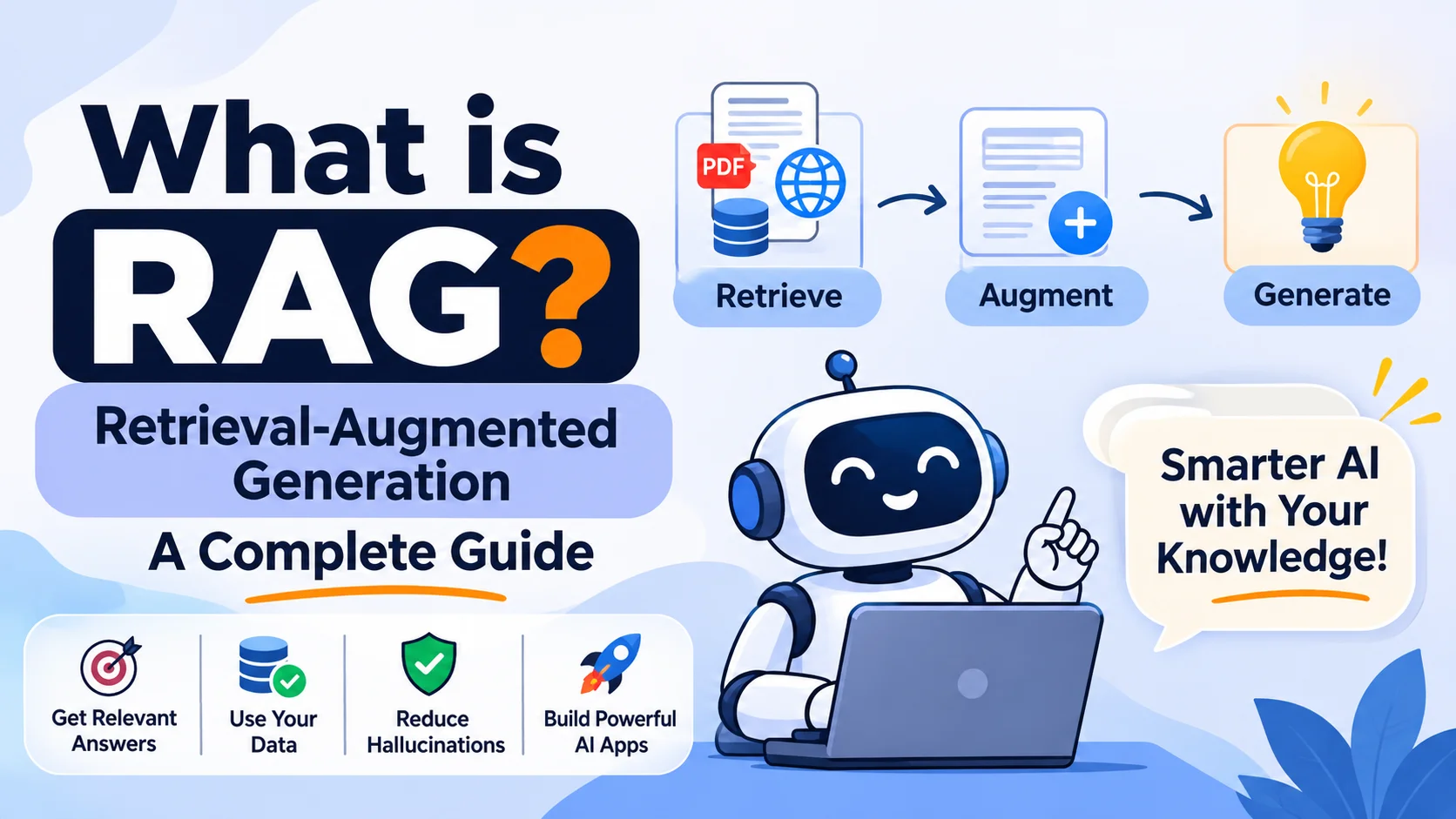
A typical RAG system works through three main stages: Retrieval, Augmentation, and Generation.
1. Retrieval
The system searches an external knowledge source to find information related to the user's question. These sources can include PDFs, Word documents, websites, databases, and internal company documents.
2. Augmentation
Once relevant information is found, the system adds it to the original question as additional context. This gives the AI model useful information before generating a response.
3. Generation
The Large Language Model processes the question along with the retrieved information and generates a natural-language response based on the available context.
Understanding the RAG Workflow
A complete RAG implementation involves several technical steps:
Data Collection: Collect information from PDFs, websites, databases, documents, and APIs.
Data Processing: Extract text, clean the content, and divide large documents into smaller sections called chunks.
Embedding Generation: Convert text chunks into numerical representations called embeddings.
Vector Database Storage: Store embeddings along with their original text and metadata.
User Query: A user submits a question through an AI-powered application.
Similarity Search: Search the vector database for relevant information.
Context Augmentation: Add retrieved information to the original question.
AI Response Generation: Generate an answer using the question and retrieved context.
What Is a Vector Database in RAG?
A vector database is an important component of many RAG applications. It allows systems to search for information based on semantic similarity rather than depending only on exact keyword matches.
For example, a search for "Where can I learn software development?" may find information containing the phrase "Our institute provides professional software training."
Some commonly used vector databases and search technologies include:
Pinecone
ChromaDB
Weaviate
Qdrant
Milvus
PostgreSQL with pgvector
Real-World Applications of RAG
1. AI Customer Support
Businesses can connect chatbots to product documentation, FAQs, and support policies to provide company-specific answers.
2. Healthcare Information Systems
Healthcare organizations can retrieve information from approved medical documents and internal knowledge sources, with appropriate privacy controls and professional oversight.
3. Education and E-Learning
Educational platforms can create AI tutors that answer questions using course materials, study notes, and learning resources.
4. Enterprise Knowledge Management
Organizations can connect AI assistants to internal documents, policies, and reports, allowing employees to search company knowledge using natural language.
5. E-Commerce Applications
Online stores can use RAG to retrieve product specifications, return policies, shipping information, and other product details.
6. Software Development
Development teams can connect AI assistants to technical documentation, API references, and code repositories to make technical information easier to access.
Benefits of Using RAG
More relevant answers: Responses can use information related to the user's actual question.
Access to private information: AI can work with authorized company documents.
Easier knowledge updates: Update the knowledge base without retraining the entire language model.
Reduced hallucinations: Retrieved information can reduce unsupported answers.
Better business integration: Connect AI applications with existing business data.
Source transparency: Show which documents were used to generate an answer.
RAG vs Traditional AI Chatbots
A traditional chatbot generally generates responses using its existing model knowledge and conversation context. A RAG-powered chatbot first searches an external knowledge base and then uses the retrieved information to generate its response.
For example, when someone asks about a company's course fee, a traditional chatbot may not know the answer. A RAG-powered chatbot can retrieve the relevant fee information from the company's course documents and provide a more specific response.
Does RAG Replace Fine-Tuning?
No. RAG and fine-tuning solve different problems. RAG provides relevant external information at the time of a query, while fine-tuning adapts a model's parameters through additional training.
RAG is often suitable for frequently updated company information. Fine-tuning may be more appropriate when adapting a model's behaviour, response style, or task-specific capabilities. Both approaches can also be used together.
What Are the Limitations of RAG?
Although RAG is powerful, it is not a perfect solution. The quality of its answers depends heavily on the quality of the information it retrieves.
Poorly structured documents can affect information extraction.
Incorrect chunk sizes can cause relevant information to be missed.
Irrelevant search results can lead to misleading answers.
Large knowledge bases require efficient indexing and retrieval.
Access permissions must be managed carefully.
AI models can still misunderstand retrieved information.
The Future of RAG in Artificial Intelligence
As businesses continue adopting AI, the need for systems that understand company-specific information is growing.
Modern RAG systems are evolving beyond simple document searches. Advanced approaches can rewrite queries, search multiple sources, rerank results, and use AI agents to decide what information is needed.
This creates opportunities for smarter customer support systems, enterprise assistants, educational platforms, and business automation tools.
Conclusion
RAG is an important technology for building AI applications that need access to external and business-specific information.
By combining information retrieval with generative AI, developers can create applications that provide more relevant, contextual, and useful answers.
Whether you are building an AI chatbot, an enterprise assistant, or an intelligent knowledge management platform, understanding RAG can help you build solutions that go beyond the capabilities of a standalone language model.
Written by
Academy Admin
Academy team