Project 01
Image Classification Using CNN
Purpose
Develop a Deep Learning model that automatically identifies and classifies images into different categories.
Business Output
An image classification model that can recognize and categorize images.
 Loading page

Neural networks and modern deep-learning techniques for advanced AI applications.
Learner rating
4.8/5
Course duration
2 Months
Learning modules
13 modules
Learning mode
Online/ Offline
Start learning.
Join 40M+ learners who transformed their careers.
By continuing, you agree to our Terms and Privacy Policy. We'll send important updates on WhatsApp.
Your next step
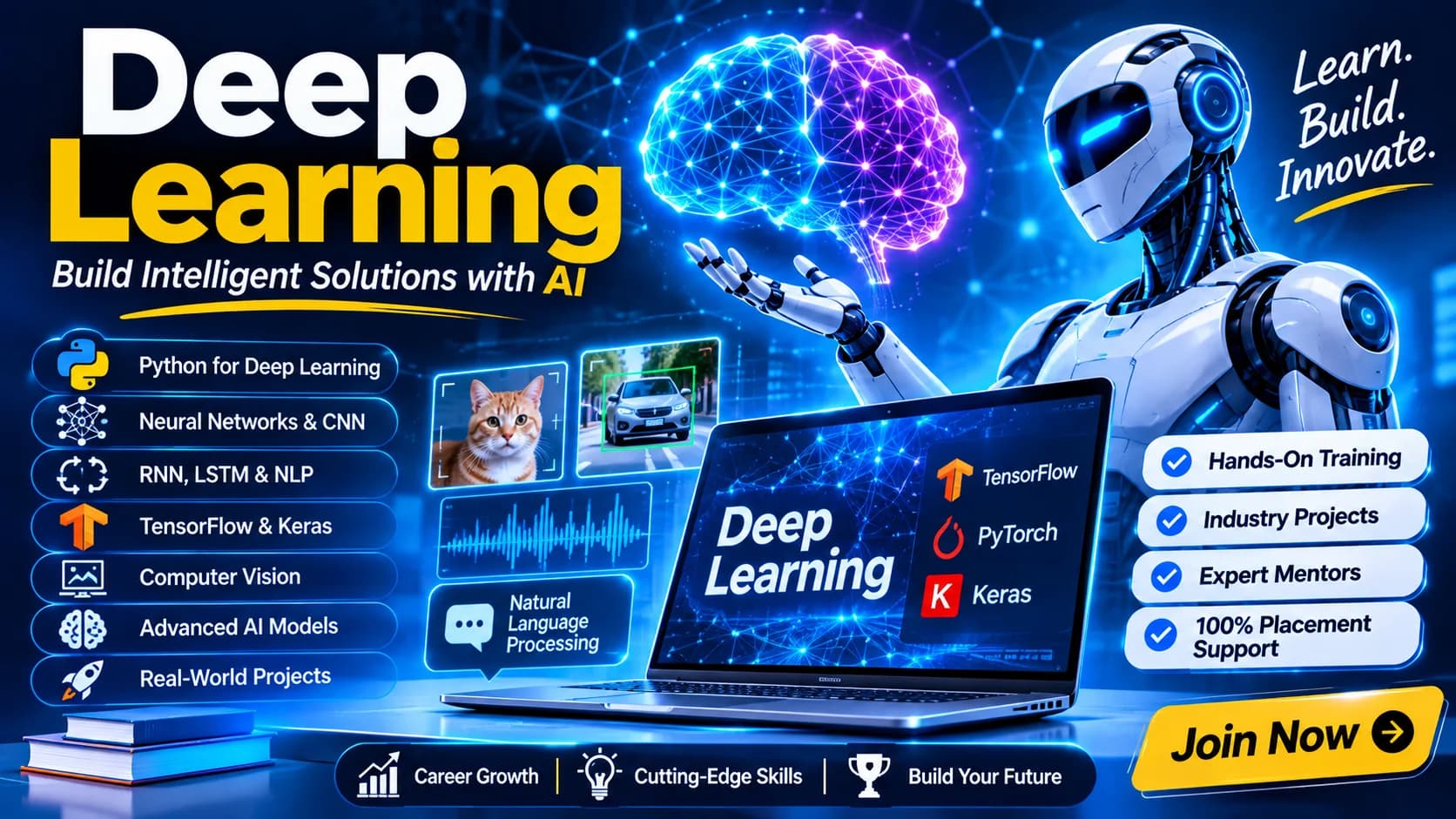
Deep Learning is a 2 Months Artificial Intelligence program built around hands-on practice, guided assignments, interview preparation, and placement support. Start with Neural Networks, practise with Python, TensorFlow, Keras, and connect your learning through applied business scenarios. Build a portfolio that explains your approach and prepare for roles such as Deep Learning Associate and Computer Vision Trainee.
2 Months structured training program
Hands-on practice with Python, TensorFlow, Keras
Live projects and portfolio-ready assignments
Certification guidance and placement assistance
A structured learning journey
Explore the curriculum, build your understanding one module at a time, and put each new skill into practice.
Find out how this curriculum fits your career goals.
Tools & technologies
Explore industry-relevant tools through hands-on learning to master practical, in-demand skills.
Build practical skills with industry-relevant learning, expert guidance, and hands-on projects designed for modern teams.
Get the complete curriculum, tools, projects, and career support details in one brochure.
Build something that matters
Every student completes 6 real-world projects — one per month — building a professional portfolio demonstrated during placement interviews.
Purpose
Develop a Deep Learning model that automatically identifies and classifies images into different categories.
Business Output
An image classification model that can recognize and categorize images.
Purpose
Build a Deep Learning model that recognizes handwritten digits from images
Business Output
A trained model that accurately recognizes handwritten digits from 0 to 9
Purpose
Develop a Deep Learning model that identifies whether a customer review expresses positive or negative sentiment.
Business Output
A sentiment analysis model that classifies customer reviews as positive or negative.
Purpose
Develop a Deep Learning model that predicts future values using historical time-series data.
Business Output
A forecasting model that predicts future trends based on historical data.
Portfolio tip: document the problem, your approach, and the result so you can walk an interviewer through your decisions.
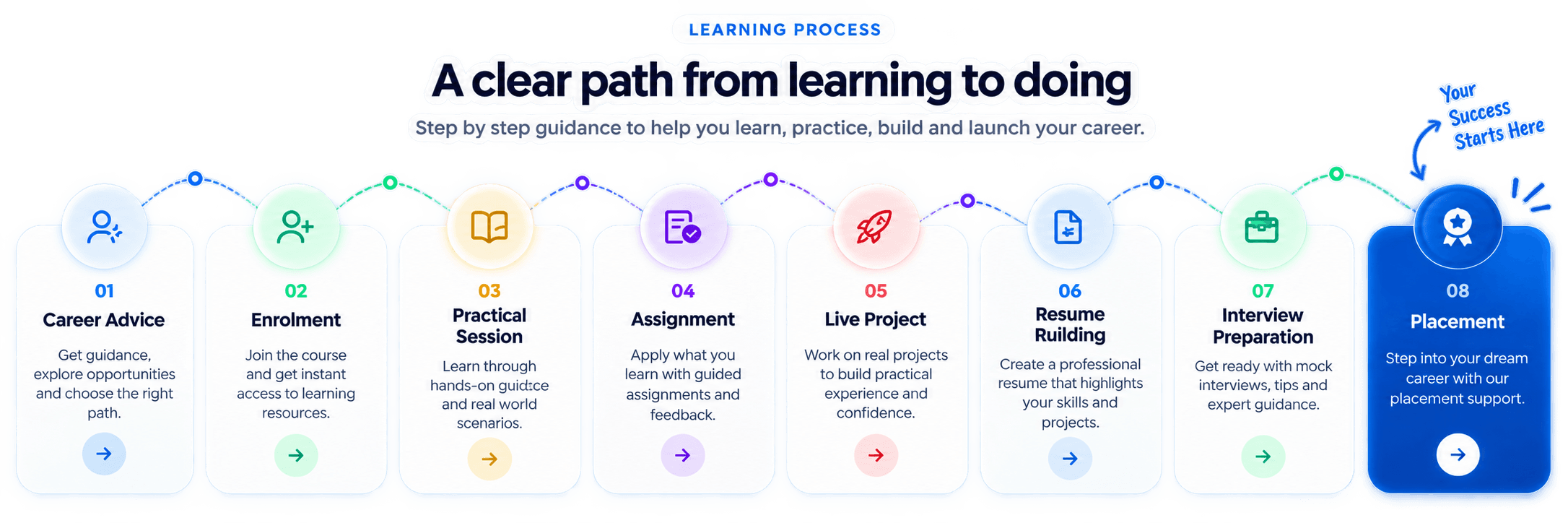
Learn more about how we have been impacting thousands of careers.
Recognition that travels with you
Certification pathway
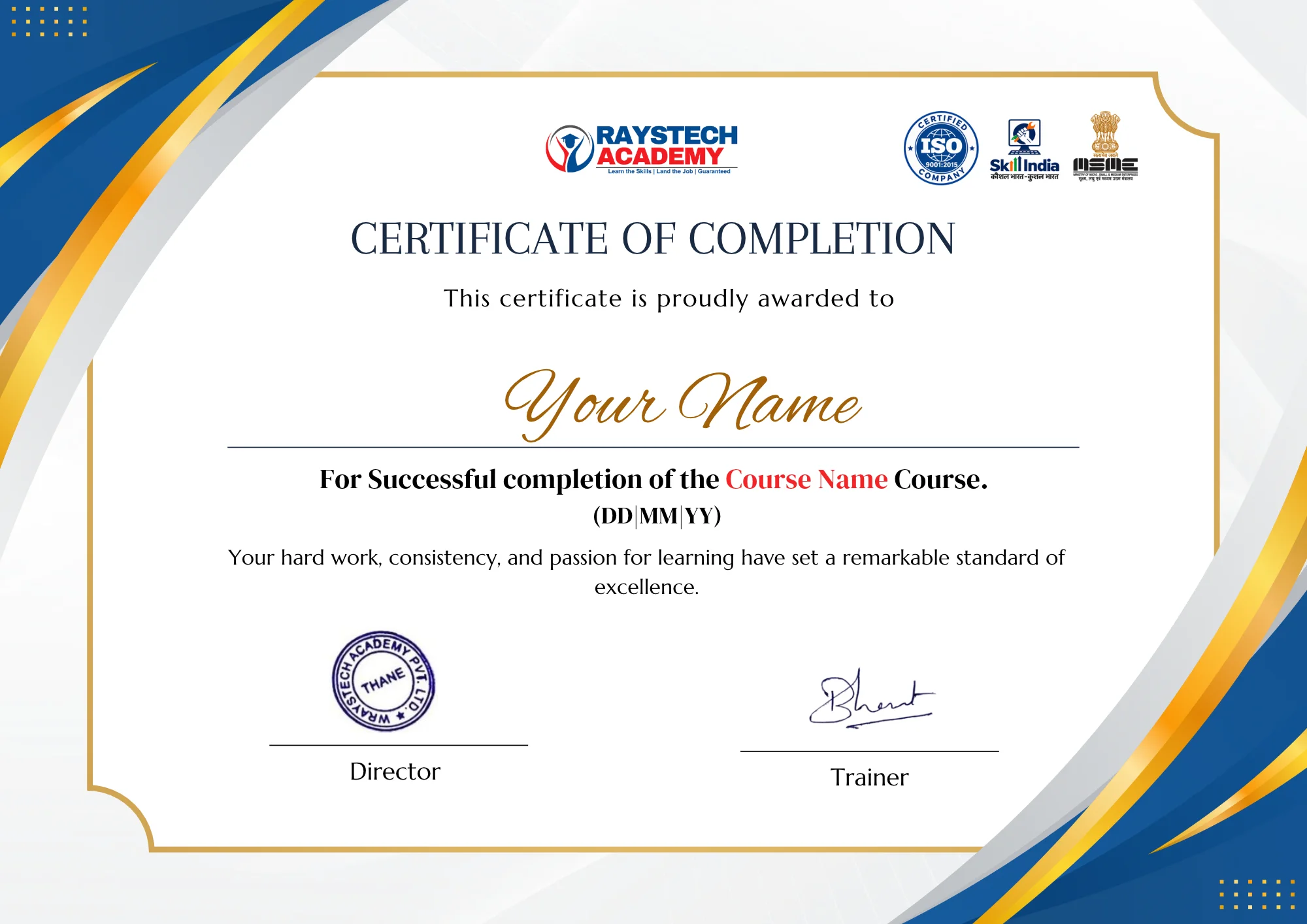
Build a credible portfolio of skills with structured preparation, practical projects, and certification guidance from experienced mentors.
Beyond the classroom
Soft skill session
Resume building
Aptitude training
LinkedIn profile building
Mock interview
Job assistance
Dedicated placement support with industry connections and recruiter interactions.




Your next opportunity starts here
 Industry-ready courseFilling fast

CAREER OUTCOME
Offer letter preview
Congratulations!
Your practical skills, projects, and career preparation can help you approach interviews with clarity and confidence.
Role-ready preparation
Portfolio, interview practice, and mentor feedback.
Career counsellor
A little more clarity
Answers to common questions about learning, projects, and getting started.
Deep Learning is a specialized branch of Machine Learning that uses artificial neural networks with multiple layers to learn complex patterns from large amounts of data. It is widely used in image recognition, speech processing, NLP and AI applications.
You will learn Python programming, neural networks, activation functions, backpropagation, optimization techniques, CNN, RNN, LSTM, NLP, TensorFlow, Keras, PyTorch and model deployment.
Students, graduates, working professionals, software developers, data analysts and individuals interested in Artificial Intelligence and Machine Learning can join this course.
Basic programming knowledge is helpful. Python is commonly used for Deep Learning, and learners will cover Python fundamentals before progressing to advanced concepts.
Basic knowledge of Python, mathematics, statistics and Machine Learning is beneficial. However, learners can build these foundations through structured training and practice.
Python is the most commonly used programming language for Deep Learning because it offers powerful libraries and frameworks such as TensorFlow, Keras and PyTorch.
The course covers Python, Jupyter Notebook, Google Colab, NumPy, Pandas, TensorFlow, Keras, PyTorch, OpenCV, NLTK, Hugging Face Transformers and Streamlit.
Machine Learning uses algorithms to identify patterns and make predictions from data. Deep Learning uses multi-layered neural networks to automatically learn complex features and patterns, often from large datasets.
CNN (Convolutional Neural Network) is commonly used for image processing and computer vision. RNN (Recurrent Neural Network) works with sequential data, while LSTM (Long Short-Term Memory) is a type of RNN designed to capture longer-term dependencies.
Yes. Students work on hands-on projects such as Image Classification Using CNN, Handwritten Digit Recognition, Sentiment Analysis Using LSTM and Time Series Forecasting Using LSTM
The course generally takes around 4–6 months, depending on the training schedule, learning pace and practical project requirements.
Learners can explore opportunities such as Deep Learning Engineer, AI Developer, Machine Learning Engineer, Computer Vision Engineer and NLP Engineer, depending on their skills, qualifications and experience.
Deep Learning involves programming, mathematics and neural network concepts, which may seem challenging initially. With structured learning, regular coding practice and practical projects, learners can gradually develop their skills.
Certificate availability and eligibility depend on the institute's course completion and assessment requirements. Contact Raystech Academy for details.
Raystech Academy provides career guidance and placement assistance to help students prepare for job opportunities through resume preparation, technical interview practice and career support.
Discuss your background, explore the course, and get help choosing a learning plan that fits your goals.
Book a Free Demo