The Three Pillars of the SAP Business AI Platform
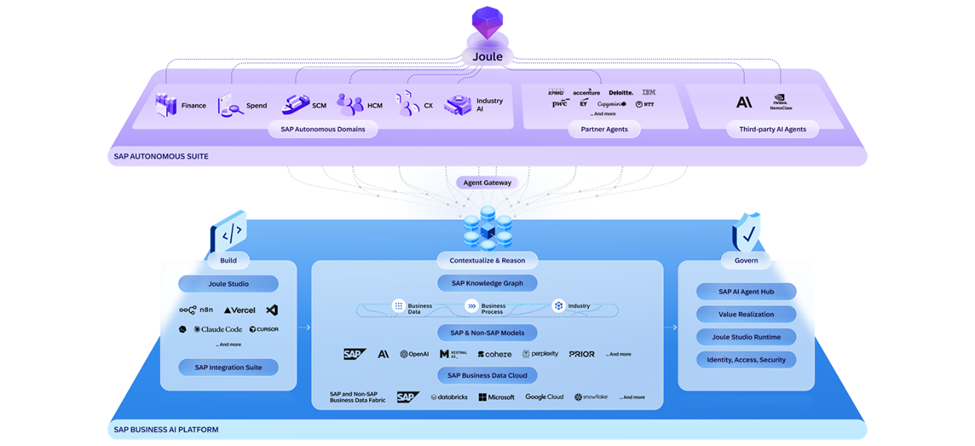
The platform is built on three core pillars that enable organizations to move from AI experimentation to productive, large-scale deployment:
Creation: This pillar focuses on building and extending AI-powered applications. It includes tools like Joule Studio, which provides a unified environment for designing and developing AI agents and workflows, and the SAP Integration Suite for connecting AI across the enterprise.
Context and Analysis: For AI to be effective in a business setting, it needs access to high-quality, relevant data. The platform uses a Business Data Fabric (powered by SAP Datasphere) to unify SAP and third-party data, providing the necessary context for AI models to reason accurately about business processes.
Governance: Scaling AI requires robust control. SAP AI Core and SAP AI Launchpad provide the infrastructure to manage the AI lifecycle, ensuring security, transparency, and compliance with corporate and regulatory standards.
Introducing Joule Studio
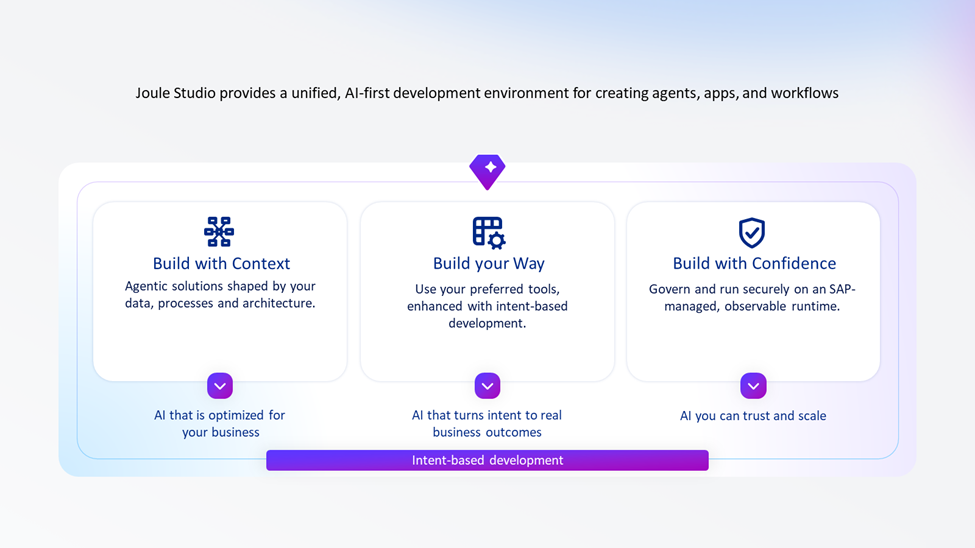
Joule Studio is SAP's unified, AI-first development environment for creating agents, applications, and workflows.
It enables organizations to develop AI-powered solutions that address specific business requirements while incorporating enterprise data, processes, and architecture.
Joule Studio combines AI-assisted development with SAP business context, flexible development tools, and enterprise governance. This helps organizations move from initial business ideas to antigenic solutions that can be deployed, managed, and improved over time.
How Joule Studio Fits into the Joule Experience
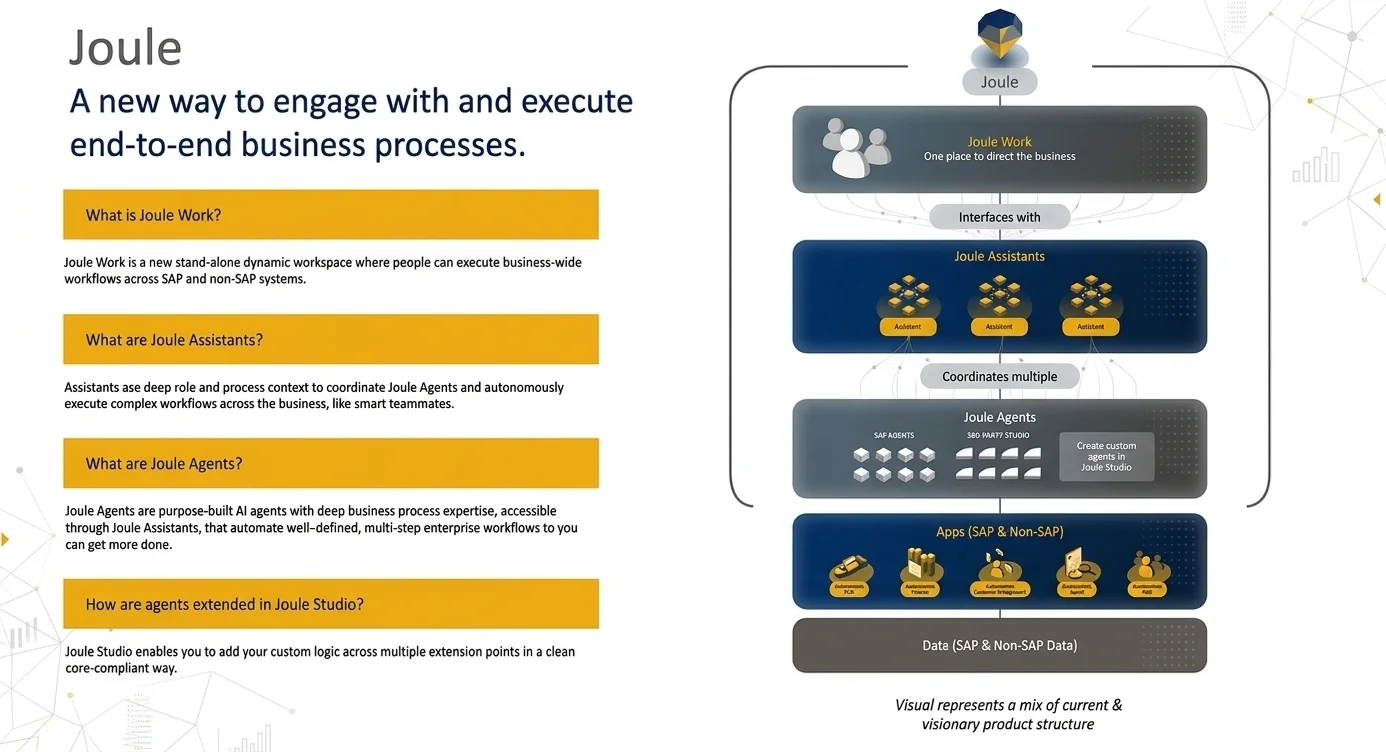
Joule Work is where business users interact with AI-powered capabilities, while Joule Studio is where developers build and extend them.
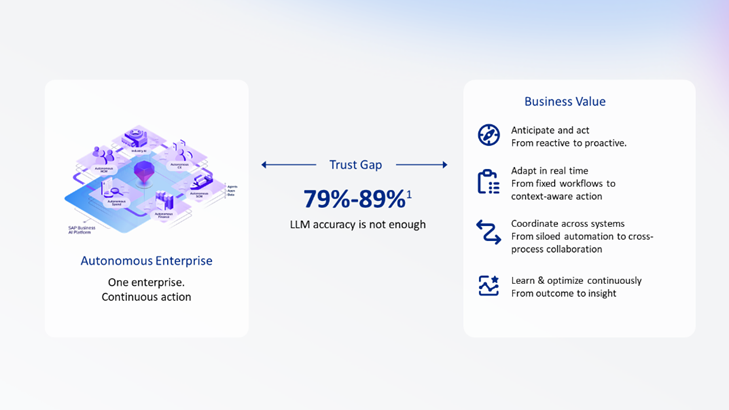
Organizations are increasingly adopting AI to move toward more autonomous business operations.
This represents a shift from reactive actions to proactive decision-making, from fixed workflows to context-aware execution, and from isolated automation to collaboration across business processes.
However, AI agents operating in enterprise environments must meet higher expectations than general-purpose AI applications.
Even strong language model performance does not automatically guarantee accurate business decisions, reliable execution, or compliance with organizational policies.
This creates a trust gap between the capabilities of AI models and the requirements of business-critical processes.
Organizations therefore need trusted agentic solutions that can understand business context, operate reliably, and remain subject to appropriate governance.
Three Principles of Trusted Agentic Solutions
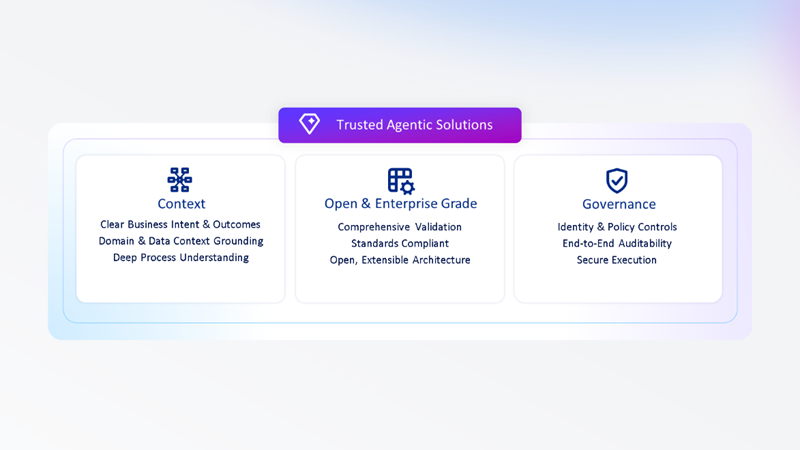
Context
AI agents need a clear understanding of the business problems they are intended to solve.
This includes business objectives, domain knowledge, enterprise data, application relationships, and business processes.
Grounding agents in this context helps them interpret information and make decisions that reflect how an organization operates.
Open and Enterprise Grade
Agentic solutions must integrate with existing enterprise architectures and operate reliably under different conditions.
They should follow established standards, support extensible architectures, and undergo comprehensive validation.
Testing must consider not only expected results but also exceptions, edge cases, and unexpected situations.
Governance
Agentic solutions must comply with enterprise policies, authorizations, and security requirements.
Governance includes identity and access controls, secure execution, and the ability to trace agent decisions and actions.
It also helps organizations understand operational performance, cost, and the business value delivered by AI agents.
From Business Intent to Trusted, Repeatable Value
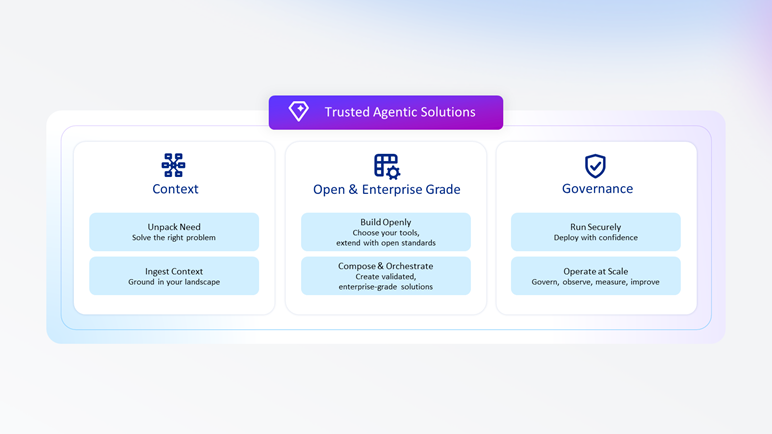
Joule Studio supports a connected approach to developing and operating trusted agentic solutions.
The process starts by understanding the business need and identifying the problem that should be solved.
Relevant business, process, and architecture context can then be incorporated to help ensure that the proposed solution fits the organization's environment.
Joule Studio supports composing and orchestrating agents, applications, and workflows into solutions that address the defined business requirements.
Developers can work with preferred tools and open standards while reviewing and refining the generated implementation.
Once validated, solutions can be deployed to a managed environment designed for secure execution.
Governance and observability support ongoing operations by providing visibility into agent behavior, performance, and opportunities for improvement.
How Joule Studio Enables Trusted Agentic Solutions
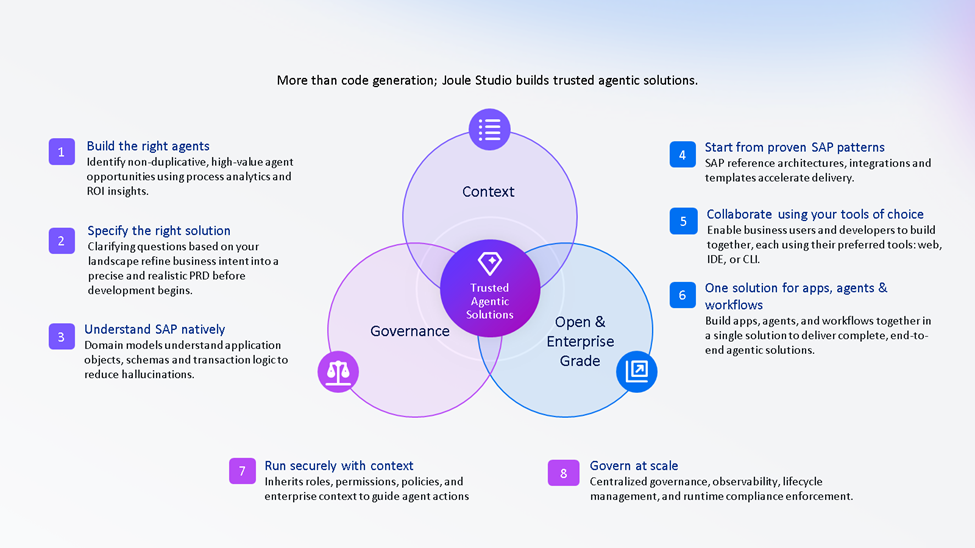
Rather than focusing exclusively on code generation, it supports identifying appropriate business opportunities, defining requirements, developing solutions, and managing their execution.
Joule Studio helps identify valuable agent opportunities using business process analysis and potential business impact. It also supports refining requirements through clarification questions that consider the enterprise landscape.
SAP domain models help interpret application objects, data structures, and transaction logic. Reference architectures, integrations, and templates provide established patterns that can guide implementation.
Joule Studio also supports developing agents, applications, and workflows together within a unified solution.
Business users and developers can collaborate using supported web-based development experiences, integrated development environments, or command-line tools.
For operational use, Joule Studio supports secure execution using enterprise context and access controls, together with governance, observability, and lifecycle management.
Written by
Academy Admin
Academy team