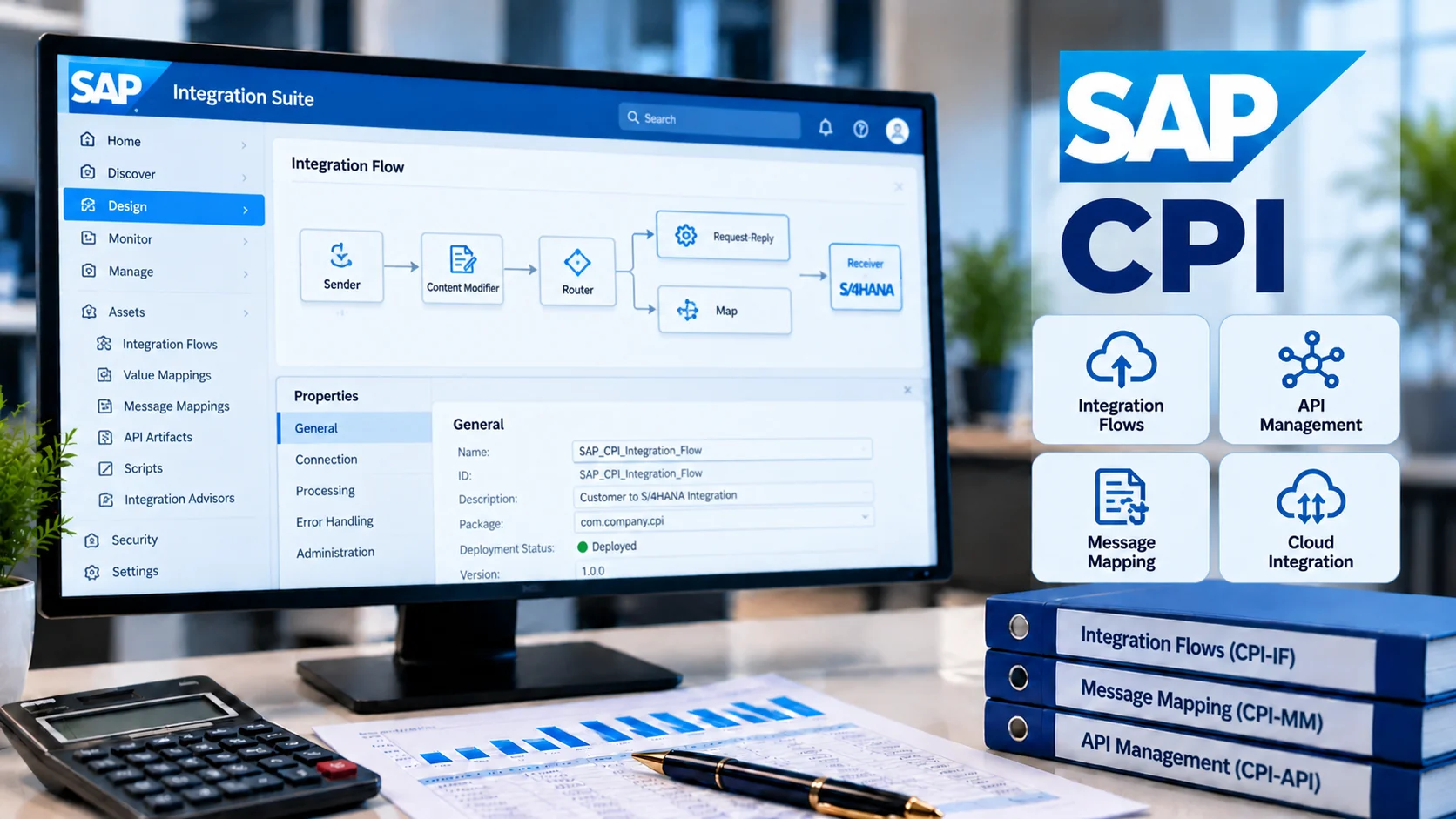
As an CPI consultant one have to make the exchange possible between systems. The exchange is made possible through message consisting of 3 parts: Header, Property and Body.
Project 1 (A2A & Hybrid): SAP S/4 HANA Business Partner & Sales Order replication to Salesforce / 3rd-Party REST API with OAuth2 & Exception Alerting
Project 2 (B2B & Cloud to On-Premise): Sucessfactos Employee Massterdata sync to SAP ERP via Cloud Connector + Automated EDI 850 Purchase Order processing
Resume building, mock technical interviews and SAP Certified Associate - Integration Developer (C_CPI) exam perparation
Find out how this curriculum fits your career goals.
Tools & technologies
Explore industry-relevant tools through hands-on learning to master practical, in-demand skills.
SAP Integration Suite
SAP Cloud Integration
SAP BTP
SAP API Management
SAP Cloud Connector
SAP Event Mesh
Integration Advisor
Open Connectors
SOAP
IDoc
Cloud Platform Integration CPI
CPI is one of the services under Integration Suite. Integration Suite is one of the pillar of BTP ( Business Technology Platform).
Build practical skills with industry-relevant learning, expert guidance, and hands-on projects designed for modern teams.
Get the complete curriculum, tools, projects, and career support details in one brochure.
Build something that matters
6 Industry Projects
Every student completes 6 real-world projects — one per month — building a professional portfolio demonstrated during placement interviews.
Portfolio tip: document the problem, your approach, and the result so you can walk an interviewer through your decisions.
95% of our students successfully get placed after completing our programs.
Learn more about how we have been impacting thousands of careers.
Recognition that travels with you
Globally recognized certifications
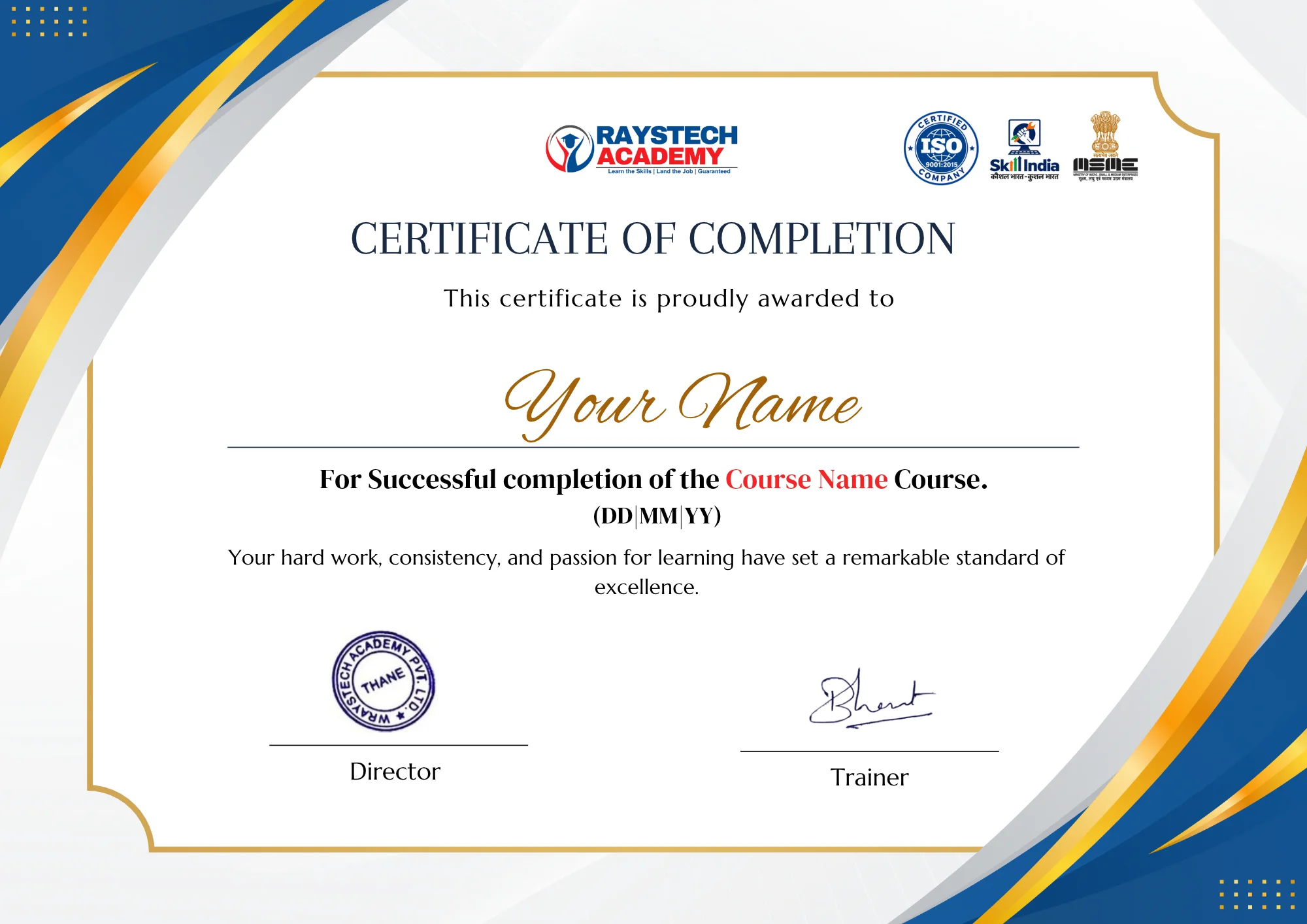
RaysTech Academy certificate
Certification pathway
Stand out with proof of practical skills.
Build a credible portfolio of skills with structured preparation, practical projects, and certification guidance from experienced mentors.
Beyond the classroom
Career Assistance Program
Soft skill session
Resume building
Aptitude training
LinkedIn profile building
Mock interview
Job assistance
Placement Assistance
Dedicated placement support with industry connections and recruiter interactions.
Up to 3 placement opportunities within 120 days of joining the Placement Bank
Career guidance with personalized counseling and mock interview preparation
Resume building & LinkedIn profile optimization
Client briefings with Git profile development and industry connect sessions
Alumni connect sessions for networking
Access your complete learning experience through our all-in-one learning portal.
SkillUpAll-in-one
01Live Mentor Sessions
02AI-Powered Practice
03Progress Tracking
04Career support
One learning hub for your complete career journey
Your next opportunity starts here
Limited seats. High demand. Enroll today.
Industry-ready courseFilling fast
Get industry-ready with Wraystech Academy
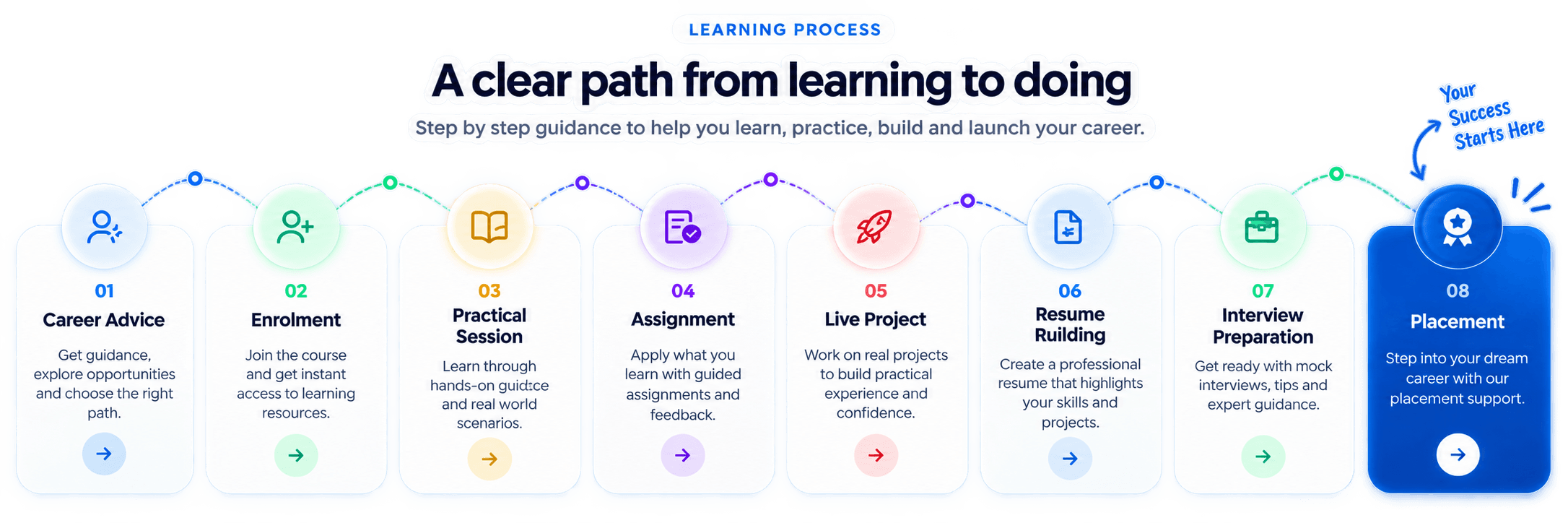
Enroll for one course and get access to the complete learning journey
In-depth curriculum with live mentor support
Integrated projects and industry-recognized certifications
Practice on real-world cases and career-ready assignments
Dedicated placement guidance and interview preparation
CAREER OUTCOME
Offer letter preview
Congratulations!
Your practical skills, projects, and career preparation can help you approach interviews with clarity and confidence.
Role-ready preparation
Portfolio, interview practice, and mentor feedback.
Career counsellor
READY
A little more clarity
Frequently asked questions
Answers to common questions about learning, projects, and getting started.
What is SAP CPI and what is its primary purpose?
SAP CPI is a cloud middleware platform designed to securely connect distinct systems across an enterprise. It enables seamless data exchange between SAP-to-SAP, SAP-to-Non-SAP, and on-premise-to-cloud architectures. It handles data transformations, message routing, and protocol translations in real time.
What is the difference between SAP CPI and SAP PI/PO?
• SAP PI/PO (Process Integration / Process Orchestration): A traditional, on-premise middleware tool installed locally on an enterprise server infrastructure.
• SAP CPI: A modern, cloud-native iPaaS (Integration Platform as a Service) hosted and fully maintained by SAP. It offers flexible subscription-based scaling and features pre-packaged, out-of-the-box integration content.
Which communication protocols and adapters are supported natively (within SAP Products)?
SAP CPI supports a wide array of built-in adapters out of the box to communicate with different endpoints.
Supported Protocols & Adapters include:
• Web Services / APIs: HTTPS, REST (OData), SOAP, RFC
• File Transfers: SFTP, FTP, IDoc
• Cloud Messaging: AMQP, JMS, Kafka, AS2, AS4, Mail
How does SAP CPI secure data transmission and integration flows?
Security is handled natively through strict multilayer mechanisms managed inside the SAP Business Technology Platform (BTP):
• Transport Security: Compulsory HTTPS, TLS encryption, and secure VPN routing via the SAP Cloud Connector.
• Authentication: Supports Client Certificate Authentication, OAuth 2.0, Basic Authentication, and SAML assertions.
• Message Level: Built-in cryptographic operations to sign, encrypt, decrypt, and verify message payloads.
What are Pre-packaged Integration Flows (iFlows) and where are they found?
The Discovery tab inside the SAP Integration Suite (available in the SAP BTP Trial Account) allows you to directly browse, explore, and clone those exact pre-packaged integration packages from the SAP Business Accelerator Hub. OR visit this site : https://discovery-center.cloud.sap/ -- no need for Trial Account.
What are SAP BTP "Open Connectors," and how do they help third-party integration?
SAP Open Connectors provide a built-in library of over 170+ preconfigured adapters for non-SAP cloud applications. Instead of building custom REST frameworks, developers use Open Connectors to instantly normalise APIs, credentials, and error handling for platforms like HubSpot, ServiceNow, and Amazon S3.
How does SAP CPI convert non-SAP data formats (like JSON) to SAP formats (like IDoc/XML)?
Third-party systems predominantly communicate via modern JSON payloads, while core SAP backends rely heavily on structural XML (IDocs/SOAP). CPI resolves this using built-in transformation blocks:
• JSON to XML / XML to JSON Converters: Instantly flips the payload script.
• Message Mapping: A graphical drag-and-drop structural map to align fields, supported by custom XSLT or Groovy scripts for high-complexity structural modifications.
Can SAP CPI integrate directly with non-SAP databases?
Yes. By deploying the JDBC (Java Database Connectivity) Receiver Adapter, CPI can securely write to, update, or read data from standard third-party databases.
Supported Non-SAP DBs include:
• Microsoft SQL Server (Cloud & On-Premise)
• PostgreSQL & MariaDB
• Oracle Database & IBM DB2
How does CPI communicate securely with an on-premise, non-SAP system behind a private firewall?
CPI relies on the SAP Cloud Connector (SCC). The SCC acts as a secure, reverse-proxy agent installed locally within the private on-premise network. It opens a secure TLS tunnel up to SAP BTP, allowing CPI to safely route data to local non-SAP endpoints without the company having to expose public IP addresses or open standard inbound firewall ports.
How are Event-Driven architectures managed with non-SAP enterprise brokers?
CPI natively hooks into modern, third-party messaging queues using specialized event adapters. For example, the Kafka Adapter or the AMQP/JMS Adapters can be configured to consume or publish live data streams. This lets CPI act as a real-time message processor interacting with event platforms like Apache Kafka or RabbitMQ.
What is the role of Groovy scripting in SAP CPI?
Groovy scripting is used to implement custom integration logic, manipulate message headers and properties, transform payloads, and handle complex data processing requirements in SAP CPI.
What is Message Mapping in SAP CPI, and how does it work?
Message Mapping transforms source message structures into target message structures. It helps exchange data between applications with different formats and field requirements.
What is the difference between synchronous and asynchronous integration in SAP CPI?
Synchronous integration waits for a response from the receiving system, whereas asynchronous integration processes messages independently without requiring an immediate response.
What is the purpose of the SAP Cloud Connector in SAP CPI?
SAP Cloud Connector establishes a secure connection between SAP BTP cloud applications and on-premise systems without exposing internal systems directly to the public internet.
What is Value Mapping in SAP CPI?
Value Mapping converts corresponding values between different systems. For example, it maps a customer status or country code from one application's format to another application's format.
How do you monitor and troubleshoot failed Integration Flows in SAP CPI?
SAP CPI provides monitoring capabilities to track message processing, identify failed integration flows, inspect error details, analyze message logs, and troubleshoot integration issues.
What is JMS in SAP CPI, and why is it used?
Java Message Service (JMS) is used for asynchronous message processing and temporary message storage. It helps manage message queues and supports reliable integration scenarios.
What is the purpose of the Partner Directory in SAP CPI?
Partner Directory stores partner-specific configuration parameters, identifiers, and values that can be accessed dynamically during integration processing.
What is the deployment process of an Integration Flow in SAP CPI?
Deployment is the process of activating an Integration Flow so that it can execute in the SAP Cloud Integration runtime. It involves configuring required parameters, deploying the flow, and monitoring its execution.
What career opportunities are available after completing SAP CPI training?
Learners can explore career opportunities such as SAP CPI Consultant, SAP Integration Developer, SAP Cloud Integration Consultant, SAP Integration Suite Consultant, and SAP Middleware Consultant.
Your next chapter starts with a conversation.
Discuss your background, explore the course, and get help choosing a learning plan that fits your goals.
SAP Agricultural Contract Management (ACM) is an SAP solution designed to manage agricultural commodity trading and contract-related business processes. It enables organizations to handle contract creation, purchasing, sales, commodity pricing, inventory management, delivery tracking, settlement and financial integration.
The SAP BASIS Training Program is designed to help learners understand SAP system administration, configuration, monitoring, and maintenance. This course covers essential SAP BASIS concepts, from fundamentals to advanced administration topics, helping learners build the technical skills required for an SAP BASIS Consultant role.